تعزيز كل قطعة من الملابس

Every well-constructed garment carries a secret. Hidden between the outer shell and the lining lies a layer of engineered fabric — the interlining — responsible for shape retention, drape quality, dimensional stability, and the satisfying heft that signals craftsmanship. Without it, collars wilt, lapels buckle, and waistbands stretch out of shape after a single wash.
Interlining (also called interfacing in home-sewing contexts) is a supplementary fabric layer applied to the wrong side of the face fabric before construction. Its role is structural rather than decorative: it modulates the mechanical properties of the outer cloth — stiffness, recovery, hand — without being visible in the finished garment.
The distinction between interlining and interfacing is largely regional. In industrial garment manufacturing and the global trade literature, "interlining" is the preferred term, encompassing the full range of fusible, sew-in, woven, and non-woven variants. "Interfacing," favoured in North American craft contexts, refers to the same concept.
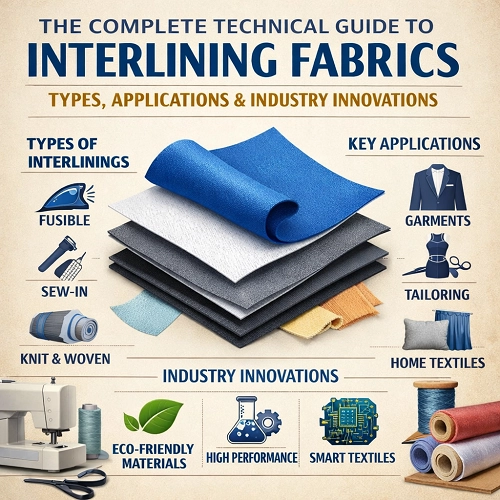
The category of interlining fabrics is far broader than it appears on the surface. Products span three primary manufacturing families — woven, knitted, and non-woven — and are further subdivided by adhesion method, weight, fibre composition, and end application.
| Category | Key Sub-Types | Typical Weight (gsm) | Primary Applications |
|---|---|---|---|
| Woven Interlining | Plain weave, Twill weave | 40 – 160 | Suit fronts, coat fronts, waistbands |
| Warp-Knitted / Tricot | Single tricot, warp knit with elasticity | 30 – 90 | Stretch garments, knit outerwear, shirt bodies |
| Non-Woven — Polyester | Spunbond, thermobonded, needled | 20 – 120 | Mass-market shirts, blouses, casual outerwear |
| Non-Woven — Nylon | Nylon spunbond, nylon thermobond | 25 – 80 | Lightweight jackets, liners, accessories |
| Needle Punch Felt | Cotton felt, polyester felt | 80 – 300 | Collar reinforcement, footwear, bag stiffeners |
| Hair Canvas | Half-canvas, full-canvas, domette | 100 – 250 | Bespoke/tailored suit fronts, chest pieces |
| Special / Enzyme-Washed | Recycled, enzyme-washed, soft-hand finishes | 30 – 90 | Casualwear, sustainable collections, denim |
Woven interlinings are engineered fabrics produced on conventional looms, typically from polyester, cotton, viscose, or blended yarns. Because their structure mirrors that of conventional woven cloth, they share many of the same directional properties: a warp direction (lengthwise) that is normally stiffer, a weft direction (crosswise) with more give, and a 45° bias direction that offers maximum drape and conformability.
The most straightforward construction — each warp yarn passes alternately over and under each weft yarn — produces a balanced, dimensionally stable fabric. Plain weave interlinings are widely used in shirt collars, cuffs, trouser waistbands, and anywhere that consistent firmness with minimal thickness is required. Their even yarn interlacing distributes stress uniformly, making them resistant to distortion under repeated washing.
In twill weave constructions, each yarn floats over two or more yarns in a staggered diagonal progression. The resulting fabric is softer in hand, more drape-friendly, and exhibits a characteristic diagonal rib on its surface. Twill interlining is preferred for suit and jacket fronts where the panel must curve smoothly around the body without creating harsh creases or stiffness at the seam lines.
UBL's woven interlining range, detailed on the woven interlining product page, spans plain and twill constructions with varying yarn deniers, enabling precise calibration of hand and weight for different garment applications.
Non-woven interlinings are produced not by weaving or knitting but by bonding fibres together through mechanical, thermal, or chemical means. They are the dominant product category globally by volume, owing to their versatility, relatively low cost, and suitability for high-speed industrial fusing.
Polyester is by far the most widely used fibre in non-woven interlining. Its advantages are compelling: dimensional stability at wash temperatures up to 60°C, resistance to shrinkage, consistent mechanical properties from roll to roll, and the ability to receive a wide range of adhesive dot geometries and densities. Polyester non-woven interlinings are the backbone of the mass-market shirt and blouse industry globally.
Nylon (polyamide) non-woven interlinings occupy a premium position in the product hierarchy. Nylon fibres are inherently softer in hand than polyester, offer superior drape characteristics, and fuse at slightly lower temperatures — making them less likely to damage heat-sensitive face fabrics such as silk, viscose, or fine wool. They are a common choice for lightweight fashion outerwear and accessories.
Needle punch felt is produced by mechanically interlocking fibres using barbed needles that repeatedly penetrate a fibre web, entangling fibres into a dense, homogeneous structure without adhesives. The result is a thick, rigid, non-fraying material used in collar stiffeners, shoulder pads, hat brims, footwear insoles, and bag stiffeners. The mechanical integrity of needle punch felt is independent of heat history, making it dimensionally stable even through multiple laundering cycles.
The majority of interlinings produced today are fusible — that is, they carry a thermoplastic adhesive coating on one face that bonds irreversibly to the face fabric under controlled conditions of heat, pressure, and time (the "HPT triangle").
Four principal adhesive chemistries are used in modern fusible interlining manufacturing:
Polyamide (PA) — the most versatile and widely used. PA adhesives bond at 140–160°C, exhibit good dry-cleaning resistance, and are compatible with most woven and non-woven substrates. They are standard on the majority of general-purpose shirt and suit interlinings.
Polyester (PES) — offers higher wash temperature resistance than PA (stable to 60°C hand wash and many machine-wash cycles) and is preferred where garments will experience frequent laundering. The bond strength of PES adhesives is somewhat lower than PA, but their plasticity makes them more forgiving during pressing.
Polyethylene (PE) — low-melt adhesives suitable for heat-sensitive face fabrics. PE coatings fuse at 110–130°C but have limited dry-cleaning resistance, restricting their use to washable garments. They are common on lightweight shirt body interlinings.
Ethylene Vinyl Acetate (EVA) — provides good adhesion at low temperatures and outstanding softness after fusing. EVA adhesives are popular in casualwear interlinings and in applications where hand retention is critical after the fusing process.
The pattern in which adhesive is deposited on the interlining substrate profoundly affects the performance of the finished bond. The main coating methods are:
| Method | Geometry | Coverage | Best For |
|---|---|---|---|
| Scatter coating | Random powder scatter | 15–35 g/m² | Economy garments, casual wear |
| Dot coating (paste) | Regular grid of circular dots | 10–25 g/m² | Standard shirts, blouses, trousers |
| Double-dot coating | Large substrate dot + small adhesive dot on top | 12–20 g/m² | Premium suits, fine wool, silk blends |
| Film / hot-melt film | Continuous thin film | 25–50 g/m² | Technical textiles, leather bonding |
| Inkjet / digital dot | Programmable dot pattern | Variable | R&D, premium custom applications |
For every combination of interlining adhesive and face fabric, the manufacturer specifies an HPT window — the acceptable ranges of temperature, pressure, and dwell time that produce a reliable bond without damaging the face fabric. Deviating from this window is the primary cause of fusing defects: bond failure (too low temperature or pressure), bleed-through of adhesive to the face (too high temperature or pressure), and fabric damage (sustained excessive heat).
Industrial flat-bed fusing presses and continuous tunnel fusing machines are engineered to maintain HPT parameters within ±2°C of the set point. The calibration of this equipment is a critical quality-assurance step in any garment factory using fusible interlinings.
The suit jacket is the most technically demanding garment from an interlining perspective. The chest piece must provide shape without restricting movement, the lapel canvas must create a clean roll line and prevent bubbling after dry cleaning, and the back body interlining (if used) must contribute to dimensional stability through the shoulder. Most contemporary suit manufacturing uses a combination of fused woven interlining in the chest and non-woven interlining at collar and facings, with hair canvas reserved for premium and bespoke product tiers.
Overcoats place the interlining under significant physical stress — the garment must retain its shape through a full season of wearing and cleaning, while the interlining bond must survive the mechanical agitation of coat pockets, button stresses, and regular dry cleaning. Heavier woven interlinings at 80–140 gsm are standard, often with double-dot adhesive coating for superior bond durability. The front facing, chest, and under-collar are the critical zones requiring the most engineered interlining specification.
The classic trench coat presents a specific challenge: the face fabric — typically tightly woven cotton gabardine or similar — has a firm hand that must be maintained while the interlining contributes weight and body without stiffness. Twill woven interlinings in the 60–90 gsm range are commonly specified for the front panels, with lighter non-woven interlinings used at yokes and back panels to manage overall garment weight.
In structured skirts and formal gowns, interlining plays a different role: providing volume and silhouette support. Lightweight to medium non-woven and warp-knit interlinings are used in bodice sections to reinforce seam areas and provide a smooth foundation for the outer fabric, while heavier needle punch constructions may appear at hems to maintain skirt shape over time.
The selection of an interlining specification requires balancing multiple variables simultaneously. The following decision framework, used by professional garment technologists, addresses the key parameters in sequence.
The outer fabric's weight, fibre content, weave structure, and thermal sensitivity set the boundary conditions for all other interlining choices. A delicate silk charmeuse demands a lightweight, low-fuse-temperature interlining; a heavyweight melton wool can accommodate a much firmer interlining at standard fusing conditions.
Consider the end-use environment: will the garment be dry-cleaned, machine-washed, or both? What temperature cycles will it experience? Is a rigid, structured hand required, or a soft, draping quality? Will the garment be subjected to high physical stress (workwear, outerwear) or low stress (fashion eveningwear)?
Based on steps 1 and 2, select between woven, non-woven, or knitted interlining. Woven substrates offer the best dimensional stability for structured garments. Non-woven substrates are cost-effective for mass production. Knitted substrates provide the stretch compatibility needed for jersey and elasticised garments.
Match adhesive chemistry and fusing parameters to the face fabric's thermal tolerance and the garment's care requirements. Always request and conduct a fuse test on the actual face fabric before bulk production — interlining suppliers routinely provide test samples for this purpose.
Subject fused samples to the garment's specified care treatment before approving the interlining specification. Evaluate for bond strength (peel test), visual appearance (bubbling, rippling, strike-through), dimensional change (shrinkage), and colour interaction between adhesive and face fabric under wet conditions.
Care Label Compliance Note: In most markets, the garment care label must reflect the most restrictive care requirement of any single component — including the interlining. Specifying a face fabric rated for 60°C machine wash alongside an interlining validated only to 40°C means the garment label must read 40°C. Confirm the interlining's wash rating before finalising label copy.
The interlining industry is responding to broader textile industry sustainability pressures with a growing range of eco-conscious product innovations. The most significant development is the adoption of recycled polyester (rPET) — derived from post-consumer PET bottles or post-industrial polyester waste — as the primary fibre in non-woven interlinings.
The environmental impact of recycled interlining depends on the feedstock, recycling process, energy supply and life cycle boundary. Any comparison with virgin material should identify the relevant product, assessment method, data source and applicable conditions.
Beyond recycled fibre, the industry is exploring bio-based adhesive systems (replacing petroleum-derived polyamides with castor oil or corn-starch-derived alternatives), waterless dyeing processes for woven interlining substrates, and take-back/recyclability programmes that address the challenge of separating fused interlining from face fabrics at end of garment life — currently one of the most technically complex problems in circular fashion.
The terms are functionally synonymous and refer to the same category of structural fabric layer. Interlining is the preferred term in industrial and international trade contexts; interfacing is more common in North American home-sewing literature. Both describe a layer of fabric applied to the wrong side of the face fabric to provide structure, firmness, or support.
Yes — provided the correct interlining type is specified for the garment's intended care regime. Polyester non-woven and warp-knit interlinings with polyester or high-quality polyamide adhesives are designed to survive repeated machine-washing at temperatures up to 40–60°C. Hair canvas interlining in bespoke suits should be dry-cleaned only. Always refer to the care instructions on the garment label, which should reflect the combined care requirements of all materials used in construction.
Bubbling (the interlining lifting away from the face fabric in irregular patches) is caused by insufficient bond formation during fusing, incorrect fusing parameters, moisture in the fabric stack before fusing, or incompatibility between adhesive chemistry and face fabric fibre type. Post-production bubbling in a finished garment indicates that the HPT parameters were outside the required window, or that the interlining specification was inappropriate for the face fabric.
A half-canvas construction uses hair canvas interlining from the chest down to approximately the button stance (roughly the top half of the jacket front), with fused non-woven interlining below and on the lapel facings. This is a mid-tier construction between full canvas (the traditional bespoke approach) and fully fused (the standard industrial approach), offering a more natural drape than full fusing at a lower production cost than full canvas.
Look for a manufacturer with demonstrated experience across multiple interlining categories, a technical team capable of advising on specification, and the testing infrastructure to validate fusing performance against your face fabrics. Jiaxing Rainbow (UBL) Interlining Co., Ltd offers direct consultation and can advise on product selection for a wide range of garment applications.